An article on mindfulness:
Present Moment Sucks
Saturday, July 7, 2012

Sunday, September 4, 2011
Lower Your Toxic Exposure
"According to a study recently published in Environmental Health Perspectives, forgoing packaged foods- such as canned foods and drinks, and packaged in plastic- could dramatically lower levels of BPA and DEHP, which disrupt hormonal balance and have been linked to birth defects, autism, early puberty, and other reproductive issues. The study authors found that when families switched to fresh foods and eliminated foods in cans and plastic containers for just three days, average levels of BPA in urine fell by more than 60% and average levels of DEHP metabolites fell by more than 50%. Participants whose exposure was highest in the toxins before the diet change had more than a 70% reduction of BPA and more than a 90% reduction of DEHP. Other ways to reduce exposure to BPA and DEHP include:
-Store food in glass or stainless steel containers.
-Never microwave food in plastic containers.
-When fresh fruits and vegetables are not available, choose frozen rather than canned."
-Store food in glass or stainless steel containers.
-Never microwave food in plastic containers.
-When fresh fruits and vegetables are not available, choose frozen rather than canned."
-Source: WellBella Sept 2011 issue
Wednesday, August 31, 2011
Turn off the TV
"A research team from the Harvard School of Public Health and the University of Southern Denmark analyzed the data from eight studies that included more than 175,000 individuals and found that watching TV for two hours a day (and Americans log a daily average of 5 hours in front of the tube!) raised the risk of type 2 diabetes by 20 percent over 8.5 years, the risk of heart disease by 15 percent over a decade and the risk of dying from any cause by 13 percent during a seven-year follow up."
Source: Dr. Andrew Weil
Source: Dr. Andrew Weil
Monday, August 8, 2011
10 Steps to Healthier Skin
The skin is the largest organ of the body. You can look at someone's skin and easily ascertain their overall health. Is it dry? Oily? Splotchy? Are they prone to breakouts? Hives? Rashes? Toxins get pushed through our skin constantly. Our skin is what protects us from the elements, meaning it is constantly exposed to dirt, fumes, sun, and wind. What can you do for healthy skin?
1. Drink more water. Filtered, clean, fresh water. Drinking 64 or more ounces of water each day will help your body function optimally. It will aid in the elimination of toxins, especially. So kick the soft drink and coffee addiction, and see how good you feel when you start drinking water!
2. Raw Honey. This speaks for itself in two ways. First, cut the refined sugars. Just a teaspoon of the stuff will lower immune function by 50% for 6 hours!!! If your immune system is struggling to keep up, your body certainly won't have any energy left over for balancing your other bodily processes. Satisfy your sweet tooth with fruit, or a teaspoon of raw honey, full of vitamins and minerals. Second, it works wonders on your skin. Mix it with an herbal masque, or slather it straight on your skin, and let it sit for a while. Wash it off and you'll notice an immediate difference.
3. Eat your fruits and veggies. I know, I know. Mom's been telling you this all along, but it it's true!! A diet high in plant foods and low in things like saturated fats, refined flours and sugars, and animal products promotes a healthy body. The skin and the digestive system are closely related, in that poor digestion can contribute to skin problems. If the digestive system can't eliminate toxins the right way, they end up cycling through the body to be eliminated via the skin. Plant foods high in vitamins and minerals, fibers, and essential fatty acids promote digestive health! So mom was right.
4. Meditate. Seriously. Many skin disorders have been linked to stress or anxiety. Just 10 minutes of quiet each day can calm your mind, soothe your body, and promote better stress management in other aspects of your life. It's important to allow the mind and body to truly be still.
5. Do some yoga. In addition to being a stress reliever, some poses, especially inversions, promote blood flow to the face. So, specifically for skin disorders that show up on the face, these can promote healthy circulation which promotes healthy skin cells, and so on.
6. Get your vitamin A. This vitamin is directly related to production of keratin, which means a lack of it can result in dry, flaky skin. So eat your red and orange veggies, and better yet, take a supplement. Mixed Carotenoids are ideal.
7. Get your vitamin C. This vitamin is directly related to collagen production, which influence elasticity of the skin. Drink your OJ, or supplement at least 1000 mg per day.
8. Burdock Root. This amazing herb is best know as an alterative (or a blood cleanser). Burdock not only cleans the blood, it also helps the digestive system, liver, and bowels. The tea can also be used as a rinse for oily hair and skin! You can take it as a tea or a tincture.
9. Check those skin care products. Lotions, soaps, creams, body washes, even make up can all contain chemicals that destroy the skin's ability to produce natural oils, maintain normal pH balance, and even be carcinogenic. Switch to castille soap for washing (it's made from saponified plant oils), and try moisturizing with jojoba oil or a lotion or cream made from organic ingredients with no chemicals, preservatives, or anything artificial. Mountain Rose Herbs sells wonderful products for skin care. It's important to wash dirt and make-up from your face every day.
10. Steam! Opening the pores of the skin allows toxins to escape. If you fill a bowl or basin with boiling water, cover your face with a towel and lean over the basin, so that the towel covers it and traps the steam. Stay there as long as you can! To steam the whole body, get the shower as hot as you can stand it and shut all the doors to the bathroom, turning off the ventilation. You can add herbs, dried or fresh, to the steam to make it more effective. Some good herbs are calendula, lavender, chamomile, and burdock.
Monday, August 1, 2011
Tally Me Banana
So, I just came across this wonderful article on bananas over at
Summer Tomato
It address some of the challenges of eating local produce
in our current culture, and also the benefits of doing so.
It's worth a read.
It address some of the challenges of eating local produce
in our current culture, and also the benefits of doing so.
It's worth a read.
Friday, July 29, 2011
Bad Breath
Lately, I've noticed a lot of bad breath. And just yesterday, it was my own! From what I know about it, mine could easily be a direct result of the detox I started 3 days ago. When the body is detoxifying, temporary halitosis can be one of the results. But thinking about it, it's not an issue that I've seen addressed much in the holistic blogosphere. So here goes. Bad breath can be caused by imbalanced bacteria on your tongue, in your mouth, or in your digestive tract. It can also be caused by inflamed sinuses, liver disease, or other health issues.
Most holistic health care professionals agree that the majority of cases are due to intestinal problems (Trivieri 991). So, the first step for battling bad breath is to help your body digest.
- Eat a diet rich in fruits and vegetables.
- Try to eat raw foods as much as possible.
- Limit sugar, dairy, yeast, alcohol, and refined grains.
- Get adequate fiber (oat bran, rice bran, psyllium).
- Take a probiotic and/or digestive enzymes.
- Drink plenty of water.
- Add lemon juice to a glass of water twice a day.
Once your system is effectively digesting your food, your bad breath should get better.
It is important to avoid alcohol based mouth washes since the alcohol kills off both good and bad bacteria.

Order Fennel seeds and other spices from Mountain Rose Herbs. Click above.
There are other ways to alleviate bad breath.
- Chew fennel seeds, cloves, coriander, cardamom, and/or anise. The oils in these spices will freshen breath (and taste delicious).
- Drink peppermint tea (and add a bit of any of the above spices).
- Clean your tongue regularly (tongue scrapers are recommended).
- Chew parsley, basil, or cilantro (chlorophyll rich herbs).
- Take homeopathic supplements (Arnica, Merc sol., Nux vom., Kali phos., Chelidonium)
- Professional intestinal cleansing.
- Herbal rinses (sage tea or black tea as the base, peppermint oil, anise oil, spearmint oil, raw honey).
So, now you can breathe easy. ;)
Most holistic health care professionals agree that the majority of cases are due to intestinal problems (Trivieri 991). So, the first step for battling bad breath is to help your body digest.
- Eat a diet rich in fruits and vegetables.
- Try to eat raw foods as much as possible.
- Limit sugar, dairy, yeast, alcohol, and refined grains.
- Get adequate fiber (oat bran, rice bran, psyllium).
- Take a probiotic and/or digestive enzymes.
- Drink plenty of water.
- Add lemon juice to a glass of water twice a day.
Once your system is effectively digesting your food, your bad breath should get better.
It is important to avoid alcohol based mouth washes since the alcohol kills off both good and bad bacteria.
Order Fennel seeds and other spices from Mountain Rose Herbs. Click above.
There are other ways to alleviate bad breath.
- Chew fennel seeds, cloves, coriander, cardamom, and/or anise. The oils in these spices will freshen breath (and taste delicious).
- Drink peppermint tea (and add a bit of any of the above spices).
- Clean your tongue regularly (tongue scrapers are recommended).
- Chew parsley, basil, or cilantro (chlorophyll rich herbs).
- Take homeopathic supplements (Arnica, Merc sol., Nux vom., Kali phos., Chelidonium)
- Professional intestinal cleansing.
- Herbal rinses (sage tea or black tea as the base, peppermint oil, anise oil, spearmint oil, raw honey).
So, now you can breathe easy. ;)
Thursday, July 28, 2011
The Vitamin D Controversy Continues
The vitamin D argument is one that has baffled me for some time. I've heard medical experts claim that we absolutely do not need high doses of vitamin D supplements, and that supplementation can, in fact, cause more harm than good. I've also heard medical experts claim that 90+% of the population is vitamin D deficient, and that we should supplement thousands of IU's per day for months before we could even begin to achieve optimum levels. In light of the less than year old release by a scientific panel from the National Academies' Institute of Medicine, which suggested tripling the RDA for vitamin D, and even more studies appearing that prove the benefits of vitamin D supplementation, and more and more people finding out they are D deficient, I feel like we should focus more energy on this issue.
Of course, every body is different, and each individual has unique needs. But, in general, the majority of Americans DO have low vitamin D levels. Dosages between 200 and 600 IU daily have been recommended to adults (varies depending on age), but more and more people are recommending even higher doses. Dr. Weil suggests that no adverse affects are seen even with daily doses approaching 10,000 IU.
I take (and have taken for a while) 400 IU per day. But I am not always able to get adequate sunlight exposure during the day, and because I eat a plant-based diet, I have few food sources (mushrooms being the only vitamin D source). So I have decided to increase my daily levels. I will begin with 1000 IU daily, and if I feel no adverse affects, will increase it slowly over time to see how it affects my body. Although I haven't had my levels tested, I can safely assume that I'm right there with the majority of deficient Americans.
As a vegan, however, I have to question the source of my vitamin D supplements. The best source (of course) is sunlight. Since most of us are terrified of being in the sun without sunscreen, we rarely if ever allow the sun's healing rays to penetrate our skin directly. Sunscreen will block the absorption of vitamin D. More on that here. Dr. Weil suggests 10 minutes of unprotected exposure on just the hands and face will help in vitamin D uptake. I've seen a number of other recommendations suggesting that 40% of your body should be exposed for 20 to 30 minutes in order to benefit from vitamin D from sunlight. Luckily, in the summer, this is easy for me. But what about in winter? And what about people who live further north?
So this leads us to actual supplements. Vitamin D is not actually a vitamin at all, but a fat soluble hormone. Supplements come in two forms. D2 (ergocalciferol) and D3 (cholecalciferol). D2 is plant derived, while D3 is animal derived. This difference becomes important to people making ethical choices about food and supplements. I've always taken D2, and consumed rice and soy milk that were fortified with D2, but I hadn't researched the difference until recently. D2 is derived from mushrooms that have been exposed to ultraviolet light. D3 is derived from sheep sebum (lanolin) or fish liver. But apparently there has been an influx of experts who claim that D3 is far superior to D2 in terms of how it functions in the body. It can be absorbed 500% faster, and binds more readily. An article here goes into further depth. Most naturopaths with a recognizable online presence suggest D3 over D2 (Dr. Weil, Mercola, Dr. Dowd). But, there are studies proving that D2 can effectively raise D levels.
So what to do? My personal ethics are simply for cruelty free eating and health. In this case, I believe there are probably companies out there who ethically produce D3 from sheep's wool. And especially if this process neither harms nor kills the animal, and even more so if these animals live good lives, then I would not be opposed to switching to D3. Sometimes optimal health means seriously considering your viewpoints, and weighing the results of each decision. For instance, I choose to eat raw honey from local, ethical beekeepers because of the health benefits local raw honey can offer. And I see that the bees are living a great life.
The search for this ethical D3 will be more complex, however, than just talking to some beekeepers at my local farmers market. It will probably involve phone calls and letters and testimonials. We will see.
In the mean time, try boosting that vitamin D intake. You might just enjoy some sunshine while you're at it!
Sunday, July 3, 2011
A Growing Awareness
Over the years, I've taken many a cross-country road trip. On this particular segment of my travels, I've noticed an emergence of shops and restaurants that cater to a health-conscious population. Sure, these places have been around, but it seems like there are more of them, and in more unlikely places. I left Tucson relatively certain that it would be impossible to find some of my staples (i.e. bulk grains like buckwheat and barley, castille soap, fluoride-free toothpaste) in places other than big cities, and even then I had my doubts. I was especially doubtful of the fact that I'd be able to find restaurants offering vegan options.
I guess I was wrong. I first of all recommend (as I have before) HappyCow. This website is an amazing resource for finding health food stores, vegan and vegetarian restaurants and other healthy options in any city around the world. In my case, though, I didn't have regular internet access for most of the trek through the southwest, so I just talked to people. Our campground hosts, people who worked in big supermarkets, people in vitamin shops, and even strangers recommended places to go. I wanted to share some of the little gem's I've found along the way:
In Del Rio, Texas
Nature's Medicine Shop
This little shop is easy to spot with it's bright green front. It's stocked full of vitamins and herbal supplements, an incredible selection of books, personal care products, and dry goods like nutritional yeast, vegan bouillon cubes, gluten-free pasta, raw snack bars, and other necessities. The woman who owns the place is incredibly nice and helpful, and she has an interesting story to boot. I couldn't find a website, though, and it's not listed on HappyCow.
In Corpus Christi, Texas
Sun Harvest
1440 Airline Rd, Corpus Christi Texas361-993-2850
This health food store is relatively large. It's got a small selection of bulk foods like dry beans and grains. It's got a small selection of organic produce tucked amidst the non-organic produce. It's got bulk organic free-trade coffee, and a couple of other staple foods like organic brown rice cakes, gluten-free tortillas, and even a small refrigerator/freezer section of some vegan health foods. It was a little disappointing due to it's size (I was expecting more of a selection) but it's the only thing of it's sort here, so I still count it as a gem.
In Lafayette, Louisiana
Masala Indian Kitchen
2208 Kaliste Saloom Rd, Lafayette Louisiana337-981-6373
This delicious Indian restaurant has vegan options right on the menu, and the food is absolutely delicious. The staff is familiar with vegan diets, too, and so can answer questions and take special requests. I definitely recommend this place.
In Nashville, Tennessee (okay, there's tons of stuff in Nashville like Whole Foods and Trader Joe's but I must give a shout out to this particular restaurant)
The Wild Cow
1896 Eastland Ave, Nashville Tennessee615-262-2717
This restaurant offers vegan and vegetarian dishes. It's tucked in a quaint little area in East Nashville, and it has a great atmosphere. What I really liked about the options here is that they were pretty much free of processed foods. Lots of vegan restaurants I've been to have entrees that all feature mock meats and fake dishes like pizzas, meatballs, hot dogs, and chicken. I have a bit of an aversion to these things, so I was refreshed to see things like beans and kale, lentil stew, and other grain and veggie options on the menu. Plus, you get your pick of quinoa or rice.
In Chesterton, Indiana
Molly Bea's Ingredients
761 Indian Boundary Road
Chesterton, IN 46304
PHONE: (219) 983-9401
This place is a gem. While the local supermarket carries organic produce and packaged goods, Molly Bea's is a bulk lovers paradise. The entire store is bulk bins. They offer an incredible selection of beans (lentils of all colors, split peas, and beans of all kinds), grains (buckwheat, barley, millet, amaranth, quinoa, and rice in varieties you've never heard of), teas (oh my, what delicious blends they have!), dried fruit, and herbs and spices (yes, whole and ground, of all kinds). I could have spent days in this shop. They even have wine tastings and tea talks in the evenings.
Au Naturel Market
1708 E Lincolnway, Valparaiso Indiana219-465-198
This little market had many of the staples we use like almond butter, raw honey, brown rice cakes, and vitamins and herbal supplements. The staff is pretty helpful too. They also have a good selection of personal care products like chlorine free feminine products, and seventh generation laundry and dish soaps.
Local Flavors
1505 2 S Calumet Rd, Chesterton Indiana219-921-0488
This little eatery features a complete vegan menu. They offer mock meat products mostly, like chicken tacos. They also have vegan mac and cheese. The food is good, and it's nice to have a vegan option on the fly. I do wish they'd offer more whole foods based dishes, though. They do have a vegan desert menu, featuring sundaes and cookies, if you're looking for a little treat.
In Cleveland, Ohio
Szechwan Garden
13800 Detroit Ave, Lakewood Ohio216-226-1987
We stumbled upon this little Chinese restaurant in the throes of hunger, and unprepared with our own food stores. It has a vegetarian menu in addition to the normal menu which features many many veggie and tofu options, and some mock meat options. We tried several of the tofu dishes, which were delicious. And the peanut sauces is to die for.
In Amherst, Massachusetts (okay there are tons of options here too like Whole Foods, Trader Joe's, and every other restaurant which has at least one vegan option, but I have to give a shout out to one in particular)
Fresh Side
39 S Pleasant St, Amherst Massachusetts413-256-0296
This restaurant has the freshest food I've had at a restaurant. The many vegan options are noted on the menu. The dishes are light and don't leave you with that feeling like most restaurants leave you with (the sort of heavy, uncomfortable, I just ate out kind of feeling). They have delicious tea rolls and soups, and the lunch menu is more affordable. Also the tea selection is great, and sitting on the sidewalk on a beautiful day with a good meal is always a treat.
Well, that's all I've got so far, but we're heading down the east coast next, so I'm sure this entry will have a second volume. Spread the word, and treat your body.
Saturday, April 16, 2011
On the road, and eating well
I've been on the road for over two weeks now, camping and sticking to the back roads. I expected to be challenged trying to eat fresh, healthy food the whole time. It's really not been as bad as I thought.
A couple things that help:
1) A food dehydrator. Before hitting the road, most nights I would make double quantities of whatever we were having for dinner. Then, I dehydrated the leftovers. It's so easy, and pretty much anything goes. I've done veggies and rice, stews, soups, chili, refried beans, hummus, pasta dishes, beans, etc. The dried food keeps in a sealed bag for months, and even longer if you freeze it. To reconstitute it, just add boiling water and let it sit for 10 minutes or so. This has been a lifesaver when grocery stores aren't nearby, or time is limited.
2) A good camping stove. We had borrowed the MSR Whisperlite stove for backpacking in Yellowstone this past year. We loved how compact it was, and how easy and efficient the setup and breakdown was. It runs on white gas. We ended up buying one for this trip, and I would highly recommend it. It packs up so small, and it works wonders. I've reconstituted meals with it and made fresh meals of all sorts including pancakes.
3) Veggie wash. In most of the small towns we've run through, the tiny grocery stores have small produce sections and absolutely no organic selection at all. So, stay away from the dirty dozen, and wash everything else with veggie wash. It's better than nothing, anyway. And I think getting fresh fruits and veggies whenever possible outweighs the pesticides in the long run.
4) Talk to people. Just by talking to locals, or especially campground hosts at state and national parks, we have learned where to buy what we are looking for. We were directed toward this wonderful health food store in Del Rio, and the woman who owned that new where to buy organic produce. It's all about finding out where to go. Especially when you can't utilize the internet for happycow.com, just ask. You'll be surprised what you can find, and where.
5) Don't give in to the convenience of "food". Eat before you leave each morning, so you won't be tempted to grab snacks from gas stations or other places. Pack a lunch each morning, or snacks from your own food stores and keep them in easy reach while driving, in case you get hungry. Even in small grocery stores, you can find whole grains and foods with limited additives if you take the time to look. Roll into a big city every once in a while, so you can stock up from somewhere that carries everything you need.
So far, eating vegan and eating healthy have been relatively easy for us. So don't think it's not possible. You don't have to sacrifice your health for the sake of the road. In fact, it's even more important to make sure you stay healthy when you're far from home, or in the wilderness. Drink lots of water, keep your grains whole, and get your fruits and veggies when you can.
Monday, January 24, 2011
Sunscreen and Your Skin
The search for a relatively toxin-free and vegan sunscreen was a difficult one, and one that I've explained in previous posts. The question, however, is whether or not sunscreen is a must at all!!
I have noticed that since adopting a healthier diet and lifestyle, my fairskinned burnsure body has been surprisingly free of sunburn. I didn't think much about it until this article was brought to my attention by another blogger.
It raises some very good points against the use of sunscreen. I'm not advocating limitless and careless sun exposure here, but some direct exposure, an awareness of your body, a healthy diet, adequate water, and a hat can work wonders. I know many people (family included) who suffered from cancerous spots and other types of dermatitis because of excess sun exposure in youth. So it is certainly important to use caution. BUT, with the array of toxins, chemicals, synthetics, and other hard to pronounce icky things contaminating sunscreen bottles, I'd say a little UV couldn't be that bad.
Do some research for yourself. Think about it. Listen to your body. Sunlight is a vital, vital ingredient to life. All living things use it readily. Why should we block out certain parts of it? Won't this affect our health?
Again, mull it over. Use caution and common sense. And weigh the issues at hand.
*As a side, the article I referenced here recommends Cod Liver Oil supplements- be cautious as this can contain mercury and other toxins commonly found in seafood. You can find oil extracted from the algae eaten by Cod and other fish, which has the same positive health benefits.
Friday, December 10, 2010
The Biology of Belief
I just finished listening to the audio version of The Biology of Belief by Dr. Bruce Lipton. I highly recommend checking this book out.
Lipton walks us through the anatomy and physiology of belief systems. If you need scientific evidence, he provides it. He suggests that we have the power to change our own perceptions (those rooted deep in the subconscious mind that cause illness, failure, unhappiness, and other negative responses to life) and thus empower our minds and bodies. The premise of the book is that through hypnotherapy, energy psychology, and mindfulness, one can find health, happiness, and any other goals one may seek.
We have the power to change our lives. I believed this before this book. But here is scientific proof.
So stop waiting for someone or something else to make you happy or healthy. :)
Vitamin D
Last week, a scientific panel from the National Academies' Institute of Medicine suggested increasing the RDA for vitamin D. They made recommendations based on all age groups, including bumping up the adult dosage to 4,000 IU daily. You can read the article here:
http://www.usnews.com/science/articles/2010/11/30/vitamin-d-targets-increased.html?s_cid=rss:vtripling itamin-d-targets-increased
However, many scientists have immediately countered and rejected these suggestions. Dr. Clifford Rosen, in this interview with NPR, suggested that actually we need very little vitamin D levels to maintain health, and that intaking too much (thousands of IU's daily) could really be harmful (increased risk of certain diseases and fractures).
http://www.npr.org/2010/11/30/131704380/panel-clarifies-vitamin-d-intake
So, what to do?
According to Patrick Holford, in The Optimum Nutrition Bible, optimal daily intake is 400 IU (this includes food and sunshine as sources). So, one only needs to supplement 120 to 200 IU.
Signs of vitamin D deficiency include soft bones and teeth, fractures, and bone curvature.
I believe it is important to consider that the average person does not get exposed to adequate sunlight each day. I also believe that most of the fortified food sources of vitamin D (dairy, etc.) are not ideal. Dairy also includes saturated fats, and often growth hormones and antibiotics. Often fortified milk contains vitamin A, which in certain forms, can actually weaken bones.
I wonder about the studies that brought about these new suggestions (and rejections) about vitamin D levels. Each person is different, and many factors could contribute to vitamin D needs. Darkness of skin, climate/latitude, sun exposure, diet (Vit D works together with calcium to strengthen bones, so if you aren't getting enough of either, you could have problems), other health concerns, etc.
In regards to vitamin D toxicity, I've found 50,000 IU to be the going number for upper intake that can cause negative affects in most adults. Signs of toxicity:
source: Merck Manual http://www.merckmanuals.com/professional/sec01/ch004/ch004k.html
Vitamin D plays a vital role in bone health, immune activity, absorption in the intestines, kidney function, parathyroid hormone secretion, and insulin secretion. So, I think it is necessary to supplement. But how much?
It is important to thoroughly consider your physical makeup and lifestyle when deciding on a recommended dose. Do your research, talk to your nutritional consultant, and consider getting your vitamin D levels tested.
http://www.usnews.com/science/articles/2010/11/30/vitamin-d-targets-increased.html?s_cid=rss:vtripling itamin-d-targets-increased
However, many scientists have immediately countered and rejected these suggestions. Dr. Clifford Rosen, in this interview with NPR, suggested that actually we need very little vitamin D levels to maintain health, and that intaking too much (thousands of IU's daily) could really be harmful (increased risk of certain diseases and fractures).
http://www.npr.org/2010/11/30/131704380/panel-clarifies-vitamin-d-intake
So, what to do?
According to Patrick Holford, in The Optimum Nutrition Bible, optimal daily intake is 400 IU (this includes food and sunshine as sources). So, one only needs to supplement 120 to 200 IU.
Signs of vitamin D deficiency include soft bones and teeth, fractures, and bone curvature.
I believe it is important to consider that the average person does not get exposed to adequate sunlight each day. I also believe that most of the fortified food sources of vitamin D (dairy, etc.) are not ideal. Dairy also includes saturated fats, and often growth hormones and antibiotics. Often fortified milk contains vitamin A, which in certain forms, can actually weaken bones.
I wonder about the studies that brought about these new suggestions (and rejections) about vitamin D levels. Each person is different, and many factors could contribute to vitamin D needs. Darkness of skin, climate/latitude, sun exposure, diet (Vit D works together with calcium to strengthen bones, so if you aren't getting enough of either, you could have problems), other health concerns, etc.
In regards to vitamin D toxicity, I've found 50,000 IU to be the going number for upper intake that can cause negative affects in most adults. Signs of toxicity:
| "Anorexia, nausea, and vomiting can develop, often followed by polyuria, polydipsia, weakness, nervousness, pruritus, and eventually renal failure. Proteinuria, urinary casts, azotemia, and metastatic calcifications (particularly in the kidneys) can develop." |
source: Merck Manual http://www.merckmanuals.com/professional/sec01/ch004/ch004k.html
Vitamin D plays a vital role in bone health, immune activity, absorption in the intestines, kidney function, parathyroid hormone secretion, and insulin secretion. So, I think it is necessary to supplement. But how much?
It is important to thoroughly consider your physical makeup and lifestyle when deciding on a recommended dose. Do your research, talk to your nutritional consultant, and consider getting your vitamin D levels tested.
Tuesday, November 23, 2010
Senate Bill S 510- Threatening the future of food
So, Senate Bill S510 is on the table... and it could be up for vote as early as tomorrow.
Here's a summary.
Here's a summary.
This bill is entitled the Food Safety Modernization Act. And while it does have many provisions for regulating food, including more accountability and testing by big food producers, it also threatens small farms and small food facilities that sell directly to local communities. This includes CSA's and other sources of fresh, organic food supplying many areas. If passed as is, this bill would mean fees and regulations for small farmers that would likely put them out of business. Urge your senators to vote FOR the Tester Amendment to this bill, which would exempt small farmers. Furthermore, do the research. If you do not support S510 in its entirety, tell your representatives!
Read about the threats imposed by S510 here.
Contact your senators here.
Don't know what to write? Try this.
Do it now! Let's protect our rights to grown our own food and save our seeds.
Read about the threats imposed by S510 here.
Contact your senators here.
Don't know what to write? Try this.
Do it now! Let's protect our rights to grown our own food and save our seeds.
Monday, November 15, 2010
The Dangers of Fluoride
Fluoride is a chemical additive found in most city water (tap water), and in multitudes of toothpastes and other dental products. As I kid, I remember coming home from the dentist with a bottle full of fluoride and being told to brush with it alone once per day.
I've heard things here and there about the dangers of fluoride, but I think that more and more research is coming out proving that it really is no good at all- especially for what it's used for (making enamel stronger). Both the Center for Disease Control and the American Dental Association have claimed that fluoride, especially when given to infants and toddlers, can cause major problems.
Fluorosis causes white and brown spots on the teeth (and presumably the bones). Over exposure to fluoride disrupts the growth process of bones and teeth, causing visible malformations. While many pro-fluoride groups claim that these defects are simply cosmetic, common sense tells us that visible flaws in the protective layers of teeth will certainly lead to other, deeper, problems.
Since most toothpaste, mouth wash, and other dental products contain fluoride, this is a very important issue. Choose toothpastes that are fluoride-free, and drink only water that has been filtered (activated charcoal and ozonated are best). This is especially important for infants and children. Research is coming out in droves about the ill effects of feeding babies formula that has been reconstituted with fluoride containing water. If you do feed your infant formula, use filtered, fluoride-free water. This is also important for children learning to brush their teeth. While fluoride containing toothpaste shouldn't be used at any age, according to many studies, it especially should not be swallowed. So for young children who haven't quite learned the rinsing technique, be certain that the toothpaste you give them is fluoride-free.
The dangers of fluoride, according to the article linked above, include:
- Disrupts synthesis of collagen
- Increased lead absorption
- Hyperactivity and/or lethargy
- Muscle disorders
- Brain damage, and lowered IQ
- Arthritis
- Bone fractures
- Lowered thyroid function
- Bone cancer
- Dementia
- Inactivates 62 enzymes
- Inhibits formation of antibodies
- Genetic damage and cell death
- Increases tumor and cancer rate
- Disrupts immune system
- Damages sperm and increases infertility
Wednesday, November 10, 2010
Make Thanksgiving Healthy
Thanksgiving is right around the corner. I absolutely adore Thanksgiving dinner- there's something about all those winter vegetables being made into beautiful and delicious meals that you share with loved ones that makes it really special. This Thanksgiving, try to make your dishes healthier- I promise they'll taste just as good, if not better.
I've chosen some good looking recipes that don't contain animal fats. I'd still tweak a couple things in some of them: use whole grain flour when it calls for white, cut the sugars and sweeteners (you never need as much as they say), use homemade instead of packaged ingredients, use oil instead of margarine, and use as many organic ingredients as possible. Otherwise, have fun planning your menu. There are some great resources out there for healthy recipe ideas. Be thankful for your health, and give that gift to your loved ones.
Tofurkey
Cornbread Stuffing
Miso Gravy
Roasted Sweet Potatoes
Apple Stuffed Acorn Squash
Thanksgiving Casserole
Pumpkin Tart

Thursday, November 4, 2010
Water = Life
Water controls pretty much all of our bodily functions. Without enough pure, filtered water, your body cannot carry out its life processes. You should be drinking:
And that is for someone of an average weight, living in an average climate. In exceptionally dry places, you should be drinking even more. Overweight people should also be drinking even more.

Water is vital for eliminating toxins (including harmful fats) from the body. Drinking more water help with many health issues, including acne, diarrhea, edema, immune function, and toxicity.
Sodas, coffee, tea, and juice don't count. Only pure water that is free of other impurities (sugars, caffeine, etc.).
This is especially important for children. Many parents give their children juices, powdered drinks, or sports drinks, and odds are high that the child is not getting enough water when these drinks are offered. I'm not even going to go into the sugar content and artificial colors and flavors contained in most of these "drinks." If you do give your child juice (once a day is ok), make sure it's 100% organic juice with no added ingredients. And dilute it with pure water. Otherwise, it is very important to offer only pure water. The growth, brain function, and health of your child is at stake. Here is an excellent site that goes a little more in depth as to the function of water and how to keep your child hydrated.
It is suggested that tap water which has been BOTH ozonated and filtered through an activated charcoal filter is the best, purest choice. If buying bottled water, choose mineral water. Never choose distilled water unless you are doing a heavy metal detox, and then only drink it for a short period, as it is lacking vital minerals.
Tap water can be harmful. In most municipalities things like chlorine and fluoride are added. Both of these things can be toxic. (More on fluoride later) Tap water may also contain carcinogens, heavy metals from the pipes, traces of phalates, etc.
There have also been suggestions that there are health benefits to drinking water both iced and at room temperature. So, have at it!
Purify your water, and drink it to your heart's content! If you are used to flavored drinks, don't worry, it doesn't take long for your taste buds to truly appreciate a glass of pure nourishing water.
Water gives us life. Let's honor that.
8 t0 10 8 oz glasses of pure water every day
(for children 2 and older)
That's 64 to 80 oz per day- almost 2.5 liters.
(for children 2 and older)
That's 64 to 80 oz per day- almost 2.5 liters.
And that is for someone of an average weight, living in an average climate. In exceptionally dry places, you should be drinking even more. Overweight people should also be drinking even more.

Water is vital for eliminating toxins (including harmful fats) from the body. Drinking more water help with many health issues, including acne, diarrhea, edema, immune function, and toxicity.
Sodas, coffee, tea, and juice don't count. Only pure water that is free of other impurities (sugars, caffeine, etc.).
This is especially important for children. Many parents give their children juices, powdered drinks, or sports drinks, and odds are high that the child is not getting enough water when these drinks are offered. I'm not even going to go into the sugar content and artificial colors and flavors contained in most of these "drinks." If you do give your child juice (once a day is ok), make sure it's 100% organic juice with no added ingredients. And dilute it with pure water. Otherwise, it is very important to offer only pure water. The growth, brain function, and health of your child is at stake. Here is an excellent site that goes a little more in depth as to the function of water and how to keep your child hydrated.
It is suggested that tap water which has been BOTH ozonated and filtered through an activated charcoal filter is the best, purest choice. If buying bottled water, choose mineral water. Never choose distilled water unless you are doing a heavy metal detox, and then only drink it for a short period, as it is lacking vital minerals.
Tap water can be harmful. In most municipalities things like chlorine and fluoride are added. Both of these things can be toxic. (More on fluoride later) Tap water may also contain carcinogens, heavy metals from the pipes, traces of phalates, etc.
There have also been suggestions that there are health benefits to drinking water both iced and at room temperature. So, have at it!
Purify your water, and drink it to your heart's content! If you are used to flavored drinks, don't worry, it doesn't take long for your taste buds to truly appreciate a glass of pure nourishing water.
Water gives us life. Let's honor that.
Sunday, October 24, 2010
To Bee or Not to Bee
One of the major decisions I've struggled with in becoming vegan is whether or not to consume honey. Most strict vegans do not consume honey, as they consider it an animal product. Some people make the claim that insects are not animals, and in this case could make the argument for using silk as well. I personally think that there is no distinction between insect and animal, as they are both living creatures, and I aim to honor all life.
That being said, I am not opposed to people consuming animal products from their own, well- loved, well-treated, non-suffering animals. For example, I know people who eat goat cheese made from the milk of their own beloved goats. I think that this still honors life. For health reasons, I definitely believe that animal products should be limited, though.
So that brings us back to honey. The bees certainly make the honey, but for some reason it seems so much different to me than meat (of course), milk, or eggs. Although there are valid arguments out there that consider the fact that honey is made from waste products of bees, and it is their own food source, therefore we should not take it from them. This, I understand.
However, I have done a lot of research, and I have learned that organic, raw, local honey has incredible health benefits. There are also some local holistic beekeepers who ensure that the bees are well provided for, have a high quality of life, and do not sugar-feed or otherwise pollute the honey.
Organic, raw, unheated honey is even safe for infants, as the existence of botulism only occurs in heated and processed honey. Here you can find out more.
It is important to note that regular honey you can buy in the store is highly processed, stripped of vitamins and minerals, and has no health benefits. Avoid buying this type of honey. Learn the differences between organic, raw and processed honey. Organic, raw honey has an extremely long shelf life.
Raw honey also promotes wound healing. Medicinal honey has been proven to help heal burns and other skin issues. Here and here are a little more about that.
It's also full of enzymes, phytochemicals, vitamins and nutrients.
It is important, though, to realize that if you rely on sweeteners (sugar, honey, syrup, etc) for your food, you should be careful because all of them are simple carbohydrates, which enter the bloodstream rapidly, causing blood sugar levels to increase, and possibly leading to insulin issues. If you want to use a sweetener, try stevia (see previous blogs).
Raw honey is great medicinally. 1 teaspoon per day has great health benefits, especially if taken along with raw apple cider vinegar.
Just make certain that you are getting local, UNHEATED, raw, organic honey. Talk to the beekeepers. Make sure they aren't sugar-feeding the bees, or otherwise treating them as less than the amazing life they are.
We must honor bees, because they pollinate most of our food.
Wednesday, October 20, 2010
Food Additives
Do you know what you're eating? Or what you're feeding your kids? It's more than a cracker, or some cereal, or your dinner. Processed food is full of all sorts of additives, many of which are thought to pose serious health risks. Some additives have been linked to cancer, diabetes, Alzheimer's, developmental problems, neurological problems, etc.
Artificial colors and flavors have no place in a healthy diet. Neither do artificial sweeteners, or artificial anything for that matter. We are live whole human beings, and we need live whole nutrients.
Take a look:
This article examines 12 food additives worth avoiding: nitrates/nitrites, BHA/ BHT, propyl gallate, monosodium glutamate (MSG), trans fats, aspartame, Acesulfame-K, food colorings: Blue 1, 2; Red 3; Green 3; and Yellow 6, olestra, potassium bromate, white sugar, and sodium chloride.
When is the last time you read your labels?
This is a great site with an alphabetical listing of additives, and a glossary following.
The easiest thing to do to protect your health is to avoid buying foods that are processed or that contain additives. If you must, however, educate yourself and understand what it is you are buying.
Check out the Sustainable Table for some more info about regulation, safety, and what to avoid.
This list of unacceptable ingredients from Whole Foods Market gives you just a glimpse of all the additives that are not worthy of being consumed.
And if it's not good to put in your body, then you won't want to put it on your body. Most body care products (shampoo, soap, shaving cream, lotion, toothpaste) contain harmful ingredients. Again, read your labels. That diaper rash cream could actually be aggravating the rash instead of healing it. And that toothpaste could be poisoning you.
Check out this list from Whole Foods.
Two of the biggest culprits here are sodium lauryl sulfate and sodium laureth sulfate. These are known skin irritants, and show up in most body care products, even your toothpaste.
Read all about them: Dangers and Info.
Consider finding products that do not contain these harmful chemicals. Better yet, make your own.
Let's stop supporting the use of harmful substances in our food supply and our hygienic products.
Saturday, October 16, 2010
Herbs and Spices
I love refilling my spice jars. I buy all my herbs and spices in bulk from Mountain Rose because they are free of chemicals and pesticides, and because of MRH's business model- they are a waste free company and do everything sustainably. Buying bulk from them also means I don't have an empty spice container every month or so. Instead I refill my glass jars.
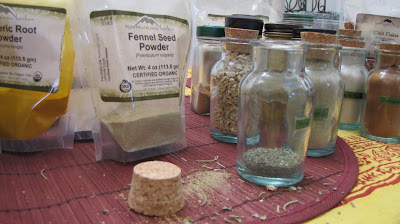
Herbs and spices are the key to every tasty meal, in my opinion. Cheese and meet have nothing on ginger and cayenne. Plus, they have incredible nutritional and medicinal benefits. Here are some more common herbs that you can add to your dinner, to spice up your health:
Cinnamon: this warming spice is also an antiseptic, so it helps fight bacteria, viruses, and other infections. It also helps your digestion. So add this unassuming medicine to your oatmeal, or if you're feeling really adventurous, to a barley sweet potato pilaf.
Fennel: this is native to the Mediterranean, and it contains flavanoids and essential fatty acids. It aids in digestion, works great for a mouthwash, and contains antiseptic oils which help fight infection. Add this to your mashed potatoes to tickle your tastebuds.
Ginger: this delicious root is ancient. Fresh or dried, it relieves nausea and congestion, gets your blood flowing, and helps with digestion. Next time you make soup, try shitake mushrooms, broccoli, ginger, cayenne, and a little soy sauce and rice vinegar. It will make you feel great.
Lavender: this lovely herb is only enjoyed aromatically by far too many people. Put it in your mouth! It's oh so lovely. It contains flavanoids and tannins (those things that are also in tea), and it relaxes the nerves, reduces fevers, helps move toxins out of the body, and can relieve vomiting. Steam some veggies and toss with some herbes de provence, starring lavender!
Parsley: so unassuming. This subtle little plant can help with allergies and respiratory issues. It's also full of vitamins and nutrients, and helps cleanse the body. Put it on everything! There's nothing parsley isn't good on.
Rosemary: for remembrance, right? Actually credible, since this little herb is a tonic. It works on the circulatory, respiratory, and digestive systems, acts as an antidepressant, and helps you relax! Rosemary lentils are one of my favorite dishes. Cook the lentils with rosemary, then add a little olive oil, sea salt, and black pepper. Yum!
Sage: with its unmistakable scent, this salvia is also ancient in use. It's loaded with vitamins and mineral, helps with congestion, digestion, blood sugar regulation, dry skin, and reproductive issues. What does it not do? Great addition to italian inspired dishes- toss over buckwheat or whole grain noodles with oregano, thyme, parsley, and basil. Add a little olive oil, throw in some veggies, and you're all set. Also one of my favorite teas.
Thyme: this delicious herb is part of the mint family. It's great for allergies, colds, and other respiratory ills. It's also antiseptic and antibacterial, so it'll help ward off infection. It's got necessary vitamins and minerals to boot. See above for a recipe idea.
So stock up! Medicine is supposed to taste good!
Wednesday, October 13, 2010
Simple Living Feature
If you want to be inundated by a wealth of wonderful information about how to live more simply, more consciously, and closer to our wonderful earth, then head on over to A Girl and Her Scout, where October is Simple Living Month.
There's tips every day, so there is a way for everyone to to reduce your ecological footprint, improve yours and your family's health and well-being, and support others who are working hard to preserve the integrity of our land, our agriculture, our animals, our air, our water, and our souls.
I am her guest blogger for part of this week, so check out my tips as well as the many others she's posted already this month.
Subscribe to:
Posts (Atom)