The vitamin D argument is one that has baffled me for some time. I've heard medical experts claim that we absolutely do not need high doses of vitamin D supplements, and that supplementation can, in fact, cause more harm than good. I've also heard medical experts claim that 90+% of the population is vitamin D deficient, and that we should supplement thousands of IU's per day for months before we could even begin to achieve optimum levels. In light of the less than year old release by a scientific panel from the National Academies' Institute of Medicine, which suggested tripling the RDA for vitamin D, and even more studies appearing that prove the benefits of vitamin D supplementation, and more and more people finding out they are D deficient, I feel like we should focus more energy on this issue.
Of course, every body is different, and each individual has unique needs. But, in general, the majority of Americans DO have low vitamin D levels. Dosages between 200 and 600 IU daily have been recommended to adults (varies depending on age), but more and more people are recommending even higher doses. Dr. Weil suggests that no adverse affects are seen even with daily doses approaching 10,000 IU.
I take (and have taken for a while) 400 IU per day. But I am not always able to get adequate sunlight exposure during the day, and because I eat a plant-based diet, I have few food sources (mushrooms being the only vitamin D source). So I have decided to increase my daily levels. I will begin with 1000 IU daily, and if I feel no adverse affects, will increase it slowly over time to see how it affects my body. Although I haven't had my levels tested, I can safely assume that I'm right there with the majority of deficient Americans.
As a vegan, however, I have to question the source of my vitamin D supplements. The best source (of course) is sunlight. Since most of us are terrified of being in the sun without sunscreen, we rarely if ever allow the sun's healing rays to penetrate our skin directly. Sunscreen will block the absorption of vitamin D. More on that here. Dr. Weil suggests 10 minutes of unprotected exposure on just the hands and face will help in vitamin D uptake. I've seen a number of other recommendations suggesting that 40% of your body should be exposed for 20 to 30 minutes in order to benefit from vitamin D from sunlight. Luckily, in the summer, this is easy for me. But what about in winter? And what about people who live further north?
So this leads us to actual supplements. Vitamin D is not actually a vitamin at all, but a fat soluble hormone. Supplements come in two forms. D2 (ergocalciferol) and D3 (cholecalciferol). D2 is plant derived, while D3 is animal derived. This difference becomes important to people making ethical choices about food and supplements. I've always taken D2, and consumed rice and soy milk that were fortified with D2, but I hadn't researched the difference until recently. D2 is derived from mushrooms that have been exposed to ultraviolet light. D3 is derived from sheep sebum (lanolin) or fish liver. But apparently there has been an influx of experts who claim that D3 is far superior to D2 in terms of how it functions in the body. It can be absorbed 500% faster, and binds more readily. An article here goes into further depth. Most naturopaths with a recognizable online presence suggest D3 over D2 (Dr. Weil, Mercola, Dr. Dowd). But, there are studies proving that D2 can effectively raise D levels.
So what to do? My personal ethics are simply for cruelty free eating and health. In this case, I believe there are probably companies out there who ethically produce D3 from sheep's wool. And especially if this process neither harms nor kills the animal, and even more so if these animals live good lives, then I would not be opposed to switching to D3. Sometimes optimal health means seriously considering your viewpoints, and weighing the results of each decision. For instance, I choose to eat raw honey from local, ethical beekeepers because of the health benefits local raw honey can offer. And I see that the bees are living a great life.
The search for this ethical D3 will be more complex, however, than just talking to some beekeepers at my local farmers market. It will probably involve phone calls and letters and testimonials. We will see.
In the mean time, try boosting that vitamin D intake. You might just enjoy some sunshine while you're at it!
Showing posts with label vitamins. Show all posts
Showing posts with label vitamins. Show all posts
Thursday, July 28, 2011

Friday, December 10, 2010
Vitamin D
Last week, a scientific panel from the National Academies' Institute of Medicine suggested increasing the RDA for vitamin D. They made recommendations based on all age groups, including bumping up the adult dosage to 4,000 IU daily. You can read the article here:
http://www.usnews.com/science/articles/2010/11/30/vitamin-d-targets-increased.html?s_cid=rss:vtripling itamin-d-targets-increased
However, many scientists have immediately countered and rejected these suggestions. Dr. Clifford Rosen, in this interview with NPR, suggested that actually we need very little vitamin D levels to maintain health, and that intaking too much (thousands of IU's daily) could really be harmful (increased risk of certain diseases and fractures).
http://www.npr.org/2010/11/30/131704380/panel-clarifies-vitamin-d-intake
So, what to do?
According to Patrick Holford, in The Optimum Nutrition Bible, optimal daily intake is 400 IU (this includes food and sunshine as sources). So, one only needs to supplement 120 to 200 IU.
Signs of vitamin D deficiency include soft bones and teeth, fractures, and bone curvature.
I believe it is important to consider that the average person does not get exposed to adequate sunlight each day. I also believe that most of the fortified food sources of vitamin D (dairy, etc.) are not ideal. Dairy also includes saturated fats, and often growth hormones and antibiotics. Often fortified milk contains vitamin A, which in certain forms, can actually weaken bones.
I wonder about the studies that brought about these new suggestions (and rejections) about vitamin D levels. Each person is different, and many factors could contribute to vitamin D needs. Darkness of skin, climate/latitude, sun exposure, diet (Vit D works together with calcium to strengthen bones, so if you aren't getting enough of either, you could have problems), other health concerns, etc.
In regards to vitamin D toxicity, I've found 50,000 IU to be the going number for upper intake that can cause negative affects in most adults. Signs of toxicity:
source: Merck Manual http://www.merckmanuals.com/professional/sec01/ch004/ch004k.html
Vitamin D plays a vital role in bone health, immune activity, absorption in the intestines, kidney function, parathyroid hormone secretion, and insulin secretion. So, I think it is necessary to supplement. But how much?
It is important to thoroughly consider your physical makeup and lifestyle when deciding on a recommended dose. Do your research, talk to your nutritional consultant, and consider getting your vitamin D levels tested.
http://www.usnews.com/science/articles/2010/11/30/vitamin-d-targets-increased.html?s_cid=rss:vtripling itamin-d-targets-increased
However, many scientists have immediately countered and rejected these suggestions. Dr. Clifford Rosen, in this interview with NPR, suggested that actually we need very little vitamin D levels to maintain health, and that intaking too much (thousands of IU's daily) could really be harmful (increased risk of certain diseases and fractures).
http://www.npr.org/2010/11/30/131704380/panel-clarifies-vitamin-d-intake
So, what to do?
According to Patrick Holford, in The Optimum Nutrition Bible, optimal daily intake is 400 IU (this includes food and sunshine as sources). So, one only needs to supplement 120 to 200 IU.
Signs of vitamin D deficiency include soft bones and teeth, fractures, and bone curvature.
I believe it is important to consider that the average person does not get exposed to adequate sunlight each day. I also believe that most of the fortified food sources of vitamin D (dairy, etc.) are not ideal. Dairy also includes saturated fats, and often growth hormones and antibiotics. Often fortified milk contains vitamin A, which in certain forms, can actually weaken bones.
I wonder about the studies that brought about these new suggestions (and rejections) about vitamin D levels. Each person is different, and many factors could contribute to vitamin D needs. Darkness of skin, climate/latitude, sun exposure, diet (Vit D works together with calcium to strengthen bones, so if you aren't getting enough of either, you could have problems), other health concerns, etc.
In regards to vitamin D toxicity, I've found 50,000 IU to be the going number for upper intake that can cause negative affects in most adults. Signs of toxicity:
| "Anorexia, nausea, and vomiting can develop, often followed by polyuria, polydipsia, weakness, nervousness, pruritus, and eventually renal failure. Proteinuria, urinary casts, azotemia, and metastatic calcifications (particularly in the kidneys) can develop." |
source: Merck Manual http://www.merckmanuals.com/professional/sec01/ch004/ch004k.html
Vitamin D plays a vital role in bone health, immune activity, absorption in the intestines, kidney function, parathyroid hormone secretion, and insulin secretion. So, I think it is necessary to supplement. But how much?
It is important to thoroughly consider your physical makeup and lifestyle when deciding on a recommended dose. Do your research, talk to your nutritional consultant, and consider getting your vitamin D levels tested.
Saturday, October 16, 2010
Herbs and Spices
I love refilling my spice jars. I buy all my herbs and spices in bulk from Mountain Rose because they are free of chemicals and pesticides, and because of MRH's business model- they are a waste free company and do everything sustainably. Buying bulk from them also means I don't have an empty spice container every month or so. Instead I refill my glass jars.
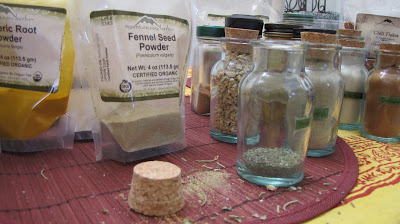
Herbs and spices are the key to every tasty meal, in my opinion. Cheese and meet have nothing on ginger and cayenne. Plus, they have incredible nutritional and medicinal benefits. Here are some more common herbs that you can add to your dinner, to spice up your health:
Cinnamon: this warming spice is also an antiseptic, so it helps fight bacteria, viruses, and other infections. It also helps your digestion. So add this unassuming medicine to your oatmeal, or if you're feeling really adventurous, to a barley sweet potato pilaf.
Fennel: this is native to the Mediterranean, and it contains flavanoids and essential fatty acids. It aids in digestion, works great for a mouthwash, and contains antiseptic oils which help fight infection. Add this to your mashed potatoes to tickle your tastebuds.
Ginger: this delicious root is ancient. Fresh or dried, it relieves nausea and congestion, gets your blood flowing, and helps with digestion. Next time you make soup, try shitake mushrooms, broccoli, ginger, cayenne, and a little soy sauce and rice vinegar. It will make you feel great.
Lavender: this lovely herb is only enjoyed aromatically by far too many people. Put it in your mouth! It's oh so lovely. It contains flavanoids and tannins (those things that are also in tea), and it relaxes the nerves, reduces fevers, helps move toxins out of the body, and can relieve vomiting. Steam some veggies and toss with some herbes de provence, starring lavender!
Parsley: so unassuming. This subtle little plant can help with allergies and respiratory issues. It's also full of vitamins and nutrients, and helps cleanse the body. Put it on everything! There's nothing parsley isn't good on.
Rosemary: for remembrance, right? Actually credible, since this little herb is a tonic. It works on the circulatory, respiratory, and digestive systems, acts as an antidepressant, and helps you relax! Rosemary lentils are one of my favorite dishes. Cook the lentils with rosemary, then add a little olive oil, sea salt, and black pepper. Yum!
Sage: with its unmistakable scent, this salvia is also ancient in use. It's loaded with vitamins and mineral, helps with congestion, digestion, blood sugar regulation, dry skin, and reproductive issues. What does it not do? Great addition to italian inspired dishes- toss over buckwheat or whole grain noodles with oregano, thyme, parsley, and basil. Add a little olive oil, throw in some veggies, and you're all set. Also one of my favorite teas.
Thyme: this delicious herb is part of the mint family. It's great for allergies, colds, and other respiratory ills. It's also antiseptic and antibacterial, so it'll help ward off infection. It's got necessary vitamins and minerals to boot. See above for a recipe idea.
So stock up! Medicine is supposed to taste good!

Herbs and spices are the key to every tasty meal, in my opinion. Cheese and meet have nothing on ginger and cayenne. Plus, they have incredible nutritional and medicinal benefits. Here are some more common herbs that you can add to your dinner, to spice up your health:
Cinnamon: this warming spice is also an antiseptic, so it helps fight bacteria, viruses, and other infections. It also helps your digestion. So add this unassuming medicine to your oatmeal, or if you're feeling really adventurous, to a barley sweet potato pilaf.
Fennel: this is native to the Mediterranean, and it contains flavanoids and essential fatty acids. It aids in digestion, works great for a mouthwash, and contains antiseptic oils which help fight infection. Add this to your mashed potatoes to tickle your tastebuds.
Ginger: this delicious root is ancient. Fresh or dried, it relieves nausea and congestion, gets your blood flowing, and helps with digestion. Next time you make soup, try shitake mushrooms, broccoli, ginger, cayenne, and a little soy sauce and rice vinegar. It will make you feel great.
Lavender: this lovely herb is only enjoyed aromatically by far too many people. Put it in your mouth! It's oh so lovely. It contains flavanoids and tannins (those things that are also in tea), and it relaxes the nerves, reduces fevers, helps move toxins out of the body, and can relieve vomiting. Steam some veggies and toss with some herbes de provence, starring lavender!
Parsley: so unassuming. This subtle little plant can help with allergies and respiratory issues. It's also full of vitamins and nutrients, and helps cleanse the body. Put it on everything! There's nothing parsley isn't good on.
Rosemary: for remembrance, right? Actually credible, since this little herb is a tonic. It works on the circulatory, respiratory, and digestive systems, acts as an antidepressant, and helps you relax! Rosemary lentils are one of my favorite dishes. Cook the lentils with rosemary, then add a little olive oil, sea salt, and black pepper. Yum!
Sage: with its unmistakable scent, this salvia is also ancient in use. It's loaded with vitamins and mineral, helps with congestion, digestion, blood sugar regulation, dry skin, and reproductive issues. What does it not do? Great addition to italian inspired dishes- toss over buckwheat or whole grain noodles with oregano, thyme, parsley, and basil. Add a little olive oil, throw in some veggies, and you're all set. Also one of my favorite teas.
Thyme: this delicious herb is part of the mint family. It's great for allergies, colds, and other respiratory ills. It's also antiseptic and antibacterial, so it'll help ward off infection. It's got necessary vitamins and minerals to boot. See above for a recipe idea.
So stock up! Medicine is supposed to taste good!
Subscribe to:
Posts (Atom)